
kerala(केरल यात्रा),India
Location : Kerala,India.
Kerala is an Indian state located on the Malabar coast of south-west India. It was formed on 1 November 1956 by the States Reorganisation Act by combining various Malayalam speaking regions.

Established : 1 November 1956
State symbols of Kerala :
State animal Indian elephant
State bird Great Hornbill
State tree Coconut tree
State flower Cassia fistula
Airports :
Kerala has three major international airports, at Thiruvananthapuram, Kochi and Kozhikode. A fourth international airport is proposed at Kannur.
Thiruvananthapuram's Trivandrum International Airport is the first International airport in an Indian non-metro city.
The Cochin International Airport is the busiest and largest in the state, and was the first Indian airport to be incorporated as a public limited company; funded by nearly 10,000 Non Resident Indians from 30 countries.
ABOUT KERALA :
Country : India
Region :South India
Capital : Thiruvananthapuram
Largest city : Thiruvananthapuram
Largest Urban agglomeration : Kochi UA
Districts : 14 total
Government
Body : Government of India,Government of Kerala
Governor : Hansraj Bhardwaj
Chief Minister : Oommen Chandy (INC)
Legislature : Unicameral (141* seats)
Parliamentary constituency : 20
High Court : Kerala High Court
Area
Total : 38,863 km2(15,005 sq mi)
Area rank : 21st
Population (2011)
Total : 33,387,677
Rank : 12th
Density : 860/km2 (2,200/sq mi)
Time zone : IST (UTC+05:30)
ISO 3166 code : IN-KL
HDI : 0.920 (very high)
HDI rank : 1st (2011)
Literacy : 93.91%(1st)
Official languages : Malayalam, English
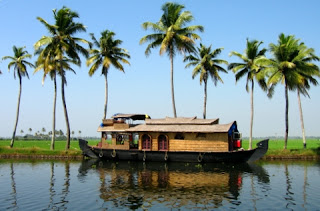
Kerala is a top tourist destination in India; backwaters, beaches, Ayurvedic tourism and tropical greenery are the major attractions.
National Geographic's Traveller magazine names Kerala as one of the "ten paradises of the world" and "50 must see destinations of a lifetime".
Travel and Leisure names Kerala as "One of the 100 great trips for the 21st century".
The Kerala Government Tourism Department, a government department in charge of promoting tourism has adopted the slogan God's Own Country for its campaigns.
History :
Prehistory
A dolmen erected by Neolithic people in Marayur.
Main article: Pre-history of Kerala
Evidence of Kerala's early human occupation includes Dolmens of the Neolithic era, in the Marayur area.
They are locally known as "muniyara", derived from muni (hermit or sage), and ara (dolmen).
Rock-engravings in the Edakkal Caves (in Wayanad) are thought to date from the early to Late Neolithic eras around 5000 B.C.
The use of a specific Indus script pictogram in these caves suggests some relationship with the Indus Valley Civilization during the late Bronze Age and early Iron Age.
Religious traditions
Parasurama, surrounded by settlers, commanding Varuna to part the seas and reveal Kerala.
The oldest of the surviving Hindu Puranas, the Matsya Purana, sets the story of the first of the incarnations of Lord Vishnu, the Matsya Avatar, and King Manu (King Satyavrata, mankind's ancestor), among Kerala's Malaya Mountains.
The earliest Sanskrit text to mention Kerala by name is the Aitareya Aranyaka of Rigveda. Hindu epics, Ramayana and Mahabharata also make a few references to Kerala.
The legendary king Mahabali is said to have ruled from Kerala in a reign of universal happiness and prosperity.
On his passing away he was appointed ruler of the netherworld (Patalam) by Vamana, the fifth avatar of Lord Vishnu.
There is a belief that, Once a year, during the Onam festival, he returns to Kerala.
Ancient period
Kerala was a major spice exporter as early as 3,000 BCE, according to Sumerian Records.
The word "Kerala" is first mentioned (as "Keralaputra") in a third century BCE rock inscription (Rock Edict 2) left by the Maurya emperor Asoka.
Kerala and Tamil Nadu once shared a common language and culture, within an area known as Tamiḻakam.
In the 1st century BCE, Tamil-speaking Dravidians established the Chera Dynasty that ruled northern Kerala and western Tamil Nadu from a capital at Vanchi.
Early medieval period
Much of history of the region from the 6th to the 8th century is obscure,a Later Chera Kingdom was established c. 800–1102, primarily with the help of Arab spice merchants.
This is also called the Kulasekhara dynasty of Mahodayapuram, as it was founded by Kulasekhara Varman, a Hindu Vaishnavaite alwar saint.
Ay kings ruled southern Kerala, but by the 10th century the Ay kingdom declined and became a part of the Later Chera Kingdom.
A Keralite identity, distinct from the Tamils, became linguistically separate during this period.
Colonial era
This figure illustrates the path of Vasco da Gama heading for the first time to India (black line)
The western spice-trade, especially in pepper, became increasingly lucrative.
Around the 15th century, the Portuguese began to dominate the eastern shipping trade in general, and the spice-trade in particular, culminating in Vasco Da Gama's arrival in Kappad Kozhikode in 1498.
Dutch commander De Lannoy surrenders to Marthanda Varma at the Battle of Colachel. Depiction at Padmanabhapuram Palace
Post Colonial period
After British India was partitioned in 1947 into India and Pakistan, Travancore and Cochin joined the Union of India and on 1 July 1949 were merged to form Travancore-Cochin.
On 1 January 1950 (Republic Day), Travancore-Cochin was recognised as a state.
The Madras Presidency was organised to form Madras State in 1947.
Fisheries :
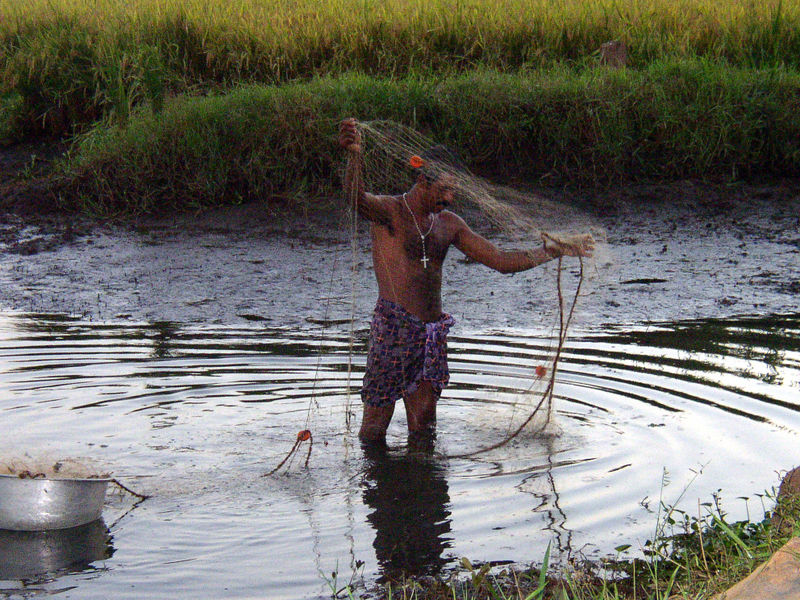
A fisherman in rural Kerala
With 590 km of coastal belt, 400,000 hectares of inland water resources and about 220,000 active fishermen, Kerala is the leading producer of fish among the states of India.
According to 2003–04 reports, about 1.1 million people earn their livelihood from fishing and allied activities such as drying, processing, packaging, exporting and transporting fisheries.
The annual yield of the sector was estimated as 608,000 tons in 2003–04.
This contributes to about 3% of the total economy of the state. In 2006, about 22% of the total Indian marine fishery yield was from Kerala industry.
Inland water transport in Kerala
Kerala, with numerous backwaters, is one of the States in India where waterways are successfully used for commercial Inland Water Transport. The transportation is mainly done with country craft and passenger vessels.

Education :
The University of Kerala's administrative building in Thiruvananthapuram.
Kerala successfully overcame the first generation issues in education and it was the 1st state in India to be recognized as a totally literate state in 1991, though the effective literacy rate was 90 per cent at that time.
The net enrollment in elementary education is almost 100 per cent and now it is almost balanced among different sexes, social groups and regions, unlike other states of India. It has the highest literacy rate among the states of India.
State topped the Education Development Index (EDI) among 21 major states in India in year 2006–2007.
According to the first Economic Census conducted in 1977, 99.7 per cent of the villages in Kerala had a primary school within 2 km, 98.6 had a middle school within 2 km and 96.7 per cent had a high school or higher secondary school within 5 km, far ahead of national averages.
Kerala successfully overcame the first generation issues in education and it was the 1st state in India to be recognized as a totally literate state in 1991, though the effective literacy rate was 90 per cent at that time.
The net enrollment in elementary education is almost 100 per cent and now it is almost balanced among different sexes, social groups and regions, unlike other states of India.
It has the highest literacy rate among the states of India.
State topped the Education Development Index (EDI) among 21 major states in India in year 2006–2007.
According to the first Economic Census conducted in 1977, 99.7 per cent of the villages in Kerala had a primary school within 2 km, 98.6 had a middle school within 2 km and 96.7 per cent had a high school or higher secondary school within 5 km, far ahead of national averages.

Culture :
Culture of Kerala is composite and cosmopolitan in nature and it's an integral part of Indian culture. It has been elaborated upon through centuries of contact with neighboring and overseas cultures.
However, the geographical insularity of Kerala from the rest of the country has caused to develop some distinctive outlook in every spheres of culture like lifestyle, art, architecture, language, literature and different social institutions.
Origin of dance and music in Kerala could be traced to the tribal art forms and folk songs which were performed in those early days to propitiate the local deities.
With the arrival of Aryan Brahmins in Kerala (8th century CE), who were instrumental in the development of many semi-classical art forms of Kerala, Hindu temples and associated institutions took over the role of development of many ritualistic art forms; emergence of new temple arts like Koodiyattom, Koothu and Kathakali have to be seen in this context.
Koodiyattom, which emerged as a popular temple art by 9th century, is a Sanskrit theatre tradition, and is officially recognised by UNESCO as a Masterpiece of the Oral and Intangible Heritage of Humanity.
Kerala natanam, an offshoot of Kathakali, Kaliyattam, Mohiniaattam (dance of the enchantress), Theyyam, Thullal and Padayani are other popular performing arts of Kerala.
Of these, Kathakali and Mohiniattam are the most recognized Indian Classical Dance traditions from Kerala.


Economy :
Kerala is an Indian state located on the Malabar coast of south-west India. It was formed on 1 November 1956 by the States Reorganisation Act by combining various Malayalam speaking regions.

Established : 1 November 1956
State symbols of Kerala :
State animal Indian elephant
State bird Great Hornbill
State tree Coconut tree
State flower Cassia fistula
Airports :
Kerala has three major international airports, at Thiruvananthapuram, Kochi and Kozhikode. A fourth international airport is proposed at Kannur.
Thiruvananthapuram's Trivandrum International Airport is the first International airport in an Indian non-metro city.
The Cochin International Airport is the busiest and largest in the state, and was the first Indian airport to be incorporated as a public limited company; funded by nearly 10,000 Non Resident Indians from 30 countries.
Railways :
Beypore - Tirur (12 March 1861); Shoranur-Ernakulam (1902);m Shenkottai-Punalur (26 November 1904).
Punalur - Thiruvananthapuram (4 November 1931); Ernakulam-Kottayam(1956); Kottayam-Kollam (1958).
Thiruvananthapuram - Kanyakumari (1979).
Thrissur-Guruvayur (1994)
ABOUT KERALA :
Country : India
Region :South India
Capital : Thiruvananthapuram
Largest city : Thiruvananthapuram
Largest Urban agglomeration : Kochi UA
Districts : 14 total
Government
Body : Government of India,Government of Kerala
Governor : Hansraj Bhardwaj
Chief Minister : Oommen Chandy (INC)
Legislature : Unicameral (141* seats)
Parliamentary constituency : 20
High Court : Kerala High Court
Area
Total : 38,863 km2(15,005 sq mi)
Area rank : 21st
Population (2011)
Total : 33,387,677
Rank : 12th
Density : 860/km2 (2,200/sq mi)
Time zone : IST (UTC+05:30)
ISO 3166 code : IN-KL
HDI : 0.920 (very high)
HDI rank : 1st (2011)
Literacy : 93.91%(1st)
Official languages : Malayalam, English
Kerala is a top tourist destination in India; backwaters, beaches, Ayurvedic tourism and tropical greenery are the major attractions.
National Geographic's Traveller magazine names Kerala as one of the "ten paradises of the world" and "50 must see destinations of a lifetime".
Travel and Leisure names Kerala as "One of the 100 great trips for the 21st century".
The Kerala Government Tourism Department, a government department in charge of promoting tourism has adopted the slogan God's Own Country for its campaigns.

Inland water transport in Kerala :
Kerala, with numerous backwaters, is one of the States in India where waterways are successfully used for commercial Inland Water Transport. The transportation is mainly done with country craft and passenger vessels. There are 67 navigable rivers in Kerala. The total length of the Inland Waterways in the State is 1687 km.
History :
Prehistory
A dolmen erected by Neolithic people in Marayur.
Main article: Pre-history of Kerala
Evidence of Kerala's early human occupation includes Dolmens of the Neolithic era, in the Marayur area.
They are locally known as "muniyara", derived from muni (hermit or sage), and ara (dolmen).
Rock-engravings in the Edakkal Caves (in Wayanad) are thought to date from the early to Late Neolithic eras around 5000 B.C.
The use of a specific Indus script pictogram in these caves suggests some relationship with the Indus Valley Civilization during the late Bronze Age and early Iron Age.
Religious traditions
Parasurama, surrounded by settlers, commanding Varuna to part the seas and reveal Kerala.
The oldest of the surviving Hindu Puranas, the Matsya Purana, sets the story of the first of the incarnations of Lord Vishnu, the Matsya Avatar, and King Manu (King Satyavrata, mankind's ancestor), among Kerala's Malaya Mountains.
The earliest Sanskrit text to mention Kerala by name is the Aitareya Aranyaka of Rigveda. Hindu epics, Ramayana and Mahabharata also make a few references to Kerala.
The legendary king Mahabali is said to have ruled from Kerala in a reign of universal happiness and prosperity.
On his passing away he was appointed ruler of the netherworld (Patalam) by Vamana, the fifth avatar of Lord Vishnu.
There is a belief that, Once a year, during the Onam festival, he returns to Kerala.
Ancient period
Kerala was a major spice exporter as early as 3,000 BCE, according to Sumerian Records.
The word "Kerala" is first mentioned (as "Keralaputra") in a third century BCE rock inscription (Rock Edict 2) left by the Maurya emperor Asoka.
Kerala and Tamil Nadu once shared a common language and culture, within an area known as Tamiḻakam.
In the 1st century BCE, Tamil-speaking Dravidians established the Chera Dynasty that ruled northern Kerala and western Tamil Nadu from a capital at Vanchi.
Early medieval period
Much of history of the region from the 6th to the 8th century is obscure,a Later Chera Kingdom was established c. 800–1102, primarily with the help of Arab spice merchants.
This is also called the Kulasekhara dynasty of Mahodayapuram, as it was founded by Kulasekhara Varman, a Hindu Vaishnavaite alwar saint.
Ay kings ruled southern Kerala, but by the 10th century the Ay kingdom declined and became a part of the Later Chera Kingdom.
A Keralite identity, distinct from the Tamils, became linguistically separate during this period.
Colonial era
This figure illustrates the path of Vasco da Gama heading for the first time to India (black line)
The western spice-trade, especially in pepper, became increasingly lucrative.
Around the 15th century, the Portuguese began to dominate the eastern shipping trade in general, and the spice-trade in particular, culminating in Vasco Da Gama's arrival in Kappad Kozhikode in 1498.
Dutch commander De Lannoy surrenders to Marthanda Varma at the Battle of Colachel. Depiction at Padmanabhapuram Palace
Post Colonial period
After British India was partitioned in 1947 into India and Pakistan, Travancore and Cochin joined the Union of India and on 1 July 1949 were merged to form Travancore-Cochin.
On 1 January 1950 (Republic Day), Travancore-Cochin was recognised as a state.
The Madras Presidency was organised to form Madras State in 1947.
Fisheries :
A fisherman in rural Kerala
With 590 km of coastal belt, 400,000 hectares of inland water resources and about 220,000 active fishermen, Kerala is the leading producer of fish among the states of India.
According to 2003–04 reports, about 1.1 million people earn their livelihood from fishing and allied activities such as drying, processing, packaging, exporting and transporting fisheries.
The annual yield of the sector was estimated as 608,000 tons in 2003–04.
This contributes to about 3% of the total economy of the state. In 2006, about 22% of the total Indian marine fishery yield was from Kerala industry.
Inland water transport in Kerala
Kerala, with numerous backwaters, is one of the States in India where waterways are successfully used for commercial Inland Water Transport. The transportation is mainly done with country craft and passenger vessels.
Education :
The University of Kerala's administrative building in Thiruvananthapuram.
Kerala successfully overcame the first generation issues in education and it was the 1st state in India to be recognized as a totally literate state in 1991, though the effective literacy rate was 90 per cent at that time.
The net enrollment in elementary education is almost 100 per cent and now it is almost balanced among different sexes, social groups and regions, unlike other states of India. It has the highest literacy rate among the states of India.
State topped the Education Development Index (EDI) among 21 major states in India in year 2006–2007.
According to the first Economic Census conducted in 1977, 99.7 per cent of the villages in Kerala had a primary school within 2 km, 98.6 had a middle school within 2 km and 96.7 per cent had a high school or higher secondary school within 5 km, far ahead of national averages.
Kerala successfully overcame the first generation issues in education and it was the 1st state in India to be recognized as a totally literate state in 1991, though the effective literacy rate was 90 per cent at that time.
The net enrollment in elementary education is almost 100 per cent and now it is almost balanced among different sexes, social groups and regions, unlike other states of India.
It has the highest literacy rate among the states of India.
State topped the Education Development Index (EDI) among 21 major states in India in year 2006–2007.
According to the first Economic Census conducted in 1977, 99.7 per cent of the villages in Kerala had a primary school within 2 km, 98.6 had a middle school within 2 km and 96.7 per cent had a high school or higher secondary school within 5 km, far ahead of national averages.

Culture :
Culture of Kerala is composite and cosmopolitan in nature and it's an integral part of Indian culture. It has been elaborated upon through centuries of contact with neighboring and overseas cultures.
However, the geographical insularity of Kerala from the rest of the country has caused to develop some distinctive outlook in every spheres of culture like lifestyle, art, architecture, language, literature and different social institutions.
Origin of dance and music in Kerala could be traced to the tribal art forms and folk songs which were performed in those early days to propitiate the local deities.
With the arrival of Aryan Brahmins in Kerala (8th century CE), who were instrumental in the development of many semi-classical art forms of Kerala, Hindu temples and associated institutions took over the role of development of many ritualistic art forms; emergence of new temple arts like Koodiyattom, Koothu and Kathakali have to be seen in this context.
Koodiyattom, which emerged as a popular temple art by 9th century, is a Sanskrit theatre tradition, and is officially recognised by UNESCO as a Masterpiece of the Oral and Intangible Heritage of Humanity.
Kerala natanam, an offshoot of Kathakali, Kaliyattam, Mohiniaattam (dance of the enchantress), Theyyam, Thullal and Padayani are other popular performing arts of Kerala.
Of these, Kathakali and Mohiniattam are the most recognized Indian Classical Dance traditions from Kerala.


Economy :
| Year | Gross State Domestic Product |
|---|---|
| 1980 | 42,860 |
| 1985 | 75,200 |
| 1990 | 140,980 |
| 1995 | 387,620 |
| 2000 | 697,920 |
| 2005 | 1,025,080 |
Since independence, Kerala was managed as a democratic socialist welfare economy.
Since the 1990s, liberalisation of the mixed economy allowed onerous Licence Raj restrictions against capitalism and foreign direct investment to be lightened, leading to economic expansion and job creation.
In fiscal year 2007–2008, nominal gross state domestic product (GSDP) was 162,414.79 crore (US$32.4 billion).
Since the 1990s, liberalisation of the mixed economy allowed onerous Licence Raj restrictions against capitalism and foreign direct investment to be lightened, leading to economic expansion and job creation.
In fiscal year 2007–2008, nominal gross state domestic product (GSDP) was
162,414.79 crore (US$32.4 billion). Agriculture :
Agriculture in Kerala has passed through many phases of change.
The major change occurred in 1970s when rice production became less attractive with increased availability of rice supply all over India and decreased availability of labour supply.
Consequently, the investment in rice production decreased significantly and a major portion of the land was shifted for the cultivation of perennial tree crops and seasonal crops.
Profitability of crops in Kerala is getting reduced due to shortage of farm labourers, high price of land, uneconomic size of operational holding area.
The major change occurred in 1970s when rice production became less attractive with increased availability of rice supply all over India and decreased availability of labour supply.
Consequently, the investment in rice production decreased significantly and a major portion of the land was shifted for the cultivation of perennial tree crops and seasonal crops.
Profitability of crops in Kerala is getting reduced due to shortage of farm labourers, high price of land, uneconomic size of operational holding area.
 Read More
Add your Comment
0
comments
Read More
Add your Comment
0
comments
Ellora(वेरूळ) Cave,Aurangabad,Maharashtra,India
Location : Aurangabad,Maharashtra,India.
The cave temples and monasteries at Ellora, excavated out of the vertical face of an escarpment, are 26 km north of Aurangabad.
Built In :
These caves were built during the 5th-7th century.
Built By :
HOW TO REACH ELLORA CAVES?
Nearest Airport : Aurangabad(15km)
Nearest Railway Station : Aurangabad
Aurangabad is the nearest railway station, and there are regular trains from Mumbai,Hyderabad, Delhi, Amritsar etc. There is an overnight train from Mumbai.
By Bus :
- Aurangabad is the nearest location for inter-state buses.
- Aurangabad to Ellora is around 30km. One can reserve Auto which will charge around Rs 350-400. Or else take Govt Buses from Central bus stop (Aurangabad).
Ellora caves lay in the lap of the Chamadari hills extending over a mile and a quarter in the north-south direction and are situated 18 miles northwest of Aurangabad.
Ellora represents some 300 years of great experiments carried out by different faiths with their very different iconography and structural compulsions.
Ellora caves are finest specimens of cave temple architecture. They house elaborate facades and exquisitely adorned interiors.
These structures representing the three faiths of Hinduism, Buddhism and Jainism, were carved during 350 AD to 700 AD period. The cave monuments of Ellora were chiefly patronised by the Chalukya - Rashtrakuta rulers (7th - 10th century AD).
These cave shrines are memorable for their invaluable contribution to the enormous wealth of Indian heritage. There are 34 caves in total. These can be divided into three groups belonging roughly to three periods: Buddhist, Hindu and Jain.
Only 12 of the 34 caves are Buddhist, but even these caves incorporate the Hindu and Jain theme, demonstrating the gradual decline of Buddhism.
It took over five centuries for the Hindu, Buddhist and Jain monks to chisel out these monasteries, temples, and chapels and decorate them with remarkable imagination and detail.
Sixteen caves are the oldest in the group and were carved in the 5th century. As one enters these caves, one crosses graceful angles and steps in a high ceiling chamber where a 15 feet huge statue of Buddha is sitting in a preaching pose.
In these caves the artist has tried an element of surprise by giving them an expression of wood. Most of these 16 caves are 'Viharas' but cave number 10 is a 'Chaitya'. The 10th cave has an impression of wooden beams on its ceiling and has a small decorated window, which illuminates the sitting Buddha.
These caves are rightly called the "Vishvakarma" caves. This cave is considered to be one of the finest caves in India.
The Buddhists believe that Buddha returns after every five thousand years, thus the 12th cave has seven images of Buddha depicting his seven incarnations.
The 16th cave in the group is one of the audacious feats in architecture ever achieved. The idea was to build Kailash from a single stone. Hence it got its name, Kailasnath temple.
Mural paintings in Ellora are found in 5 caves, but only in the Kailasa temple are they somewhat preserved.
PHOTO GALLERY :


The Vishvakarma :
The Vishvakarma (Cave 10) is the only chaitya griha amongst the Buddhist group of caves.
It is locally known as Vishvakarma or Sutar ka jhopda "carpenter's hut".
It follows the pattern of construction of Caves 19 and 26 of Ajanta. On stylistic grounds, the date of construction of this cave is assigned to 700 A.D.
The chaitya once had a high screen wall, which is ruined at present.
At the front is a rock-cut court, which is entered through a flight of steps. On either side are pillared porticos with chambers in their back walls.

1)Buddhist Caves :
5 th century to 7 th century AD
Caves 1 to 12 at the southern end
hese caves were built during the 5th-7th century.
It was initially thought that the Buddhist caves were one of the earliest structures, created between the fifth and eighth centuries, with caves 1-5 in the first phase (400-600) and 6-12 in the later phase (mid 7th-mid 8th), but now it is clear to the modern scholars that some of the Hindu caves (27,29,21,28,19,26,20,17 and 14) precede these caves.
The earliest Buddhist cave is Cave 6, followed by 5,2,3,5 (right wing), 4,7,8,10 and 9.
Caves 11 and 12 were the last. All the Buddhist caves were constructed between 630-700.
Caves 11 and 12 were the last. All the Buddhist caves were constructed between 630-700.
Thomas+-+Daniell+Mountain.jpg)
2)Hindu Caves :
8 th century to 10 th century AD
Caves 13 to 29 in the middle
Hindu caves are the Rameshvara (Cave 21), which has figurines of river goddesses Ganga and Yamuna at the entrance and the Dhumar Lena (Cave 29) whose design is similar to the cave temple on Elephanta Island near Mumbai.
Two other caves, the Ravan ki Khai (Cave 14) and the Nilkantha (Cave 22) also have several sculptures. The rest of the Hindu caves, which include the Kumbharvada (Cave 25) and the Gopilena (Cave 27) have no significant sculptures
Two other caves, the Ravan ki Khai (Cave 14) and the Nilkantha (Cave 22) also have several sculptures. The rest of the Hindu caves, which include the Kumbharvada (Cave 25) and the Gopilena (Cave 27) have no significant sculptures

3)Jain Caves :
9 th century to 11 th century AD
Caves 30 to 34 at the northern end
The five Jain caves at Ellora belong to the ninth and tenth centuries. They all belong to the Digambara sect.
Jain caves reveal specific dimensions of Jain philosophy and tradition. They reflect a strict sense of asceticism – they are not relatively large as compared to others, but they present exceptionally detailed art works.
The most remarkable Jain shrines are the Chhota Kailash (cave 30), the Indra Sabha (cave 32) and the Jagannath Sabha (cave 33).
Cave 31 is an unfinished four-pillared hall and a shrine. Cave 34 is a small cave, which can be approached through an opening on the left side of Cave 33
Jain caves reveal specific dimensions of Jain philosophy and tradition. They reflect a strict sense of asceticism – they are not relatively large as compared to others, but they present exceptionally detailed art works.
The most remarkable Jain shrines are the Chhota Kailash (cave 30), the Indra Sabha (cave 32) and the Jagannath Sabha (cave 33).
Cave 31 is an unfinished four-pillared hall and a shrine. Cave 34 is a small cave, which can be approached through an opening on the left side of Cave 33
 Read More
Add your Comment
0
comments
Read More
Add your Comment
0
comments
Shirdi Sai Baba(शिर्डीचे श्री साईबाबा),Nashik,Ahmednagar,India
Location : Shirdi,Nashi,Ahmednagar,India
122 kms from Nashik is the abode of one of Maharashtra's most revered saint - Sai Baba of Shirdi.
Popularly known as the 'Child of God', Sai Baba preached tolerance towards all religions and the message of universal brotherhood.
Every activity at Shirdi revolves around the vast temple complex dedicated to Sai Baba.
Devotees start queuing up in the early hours of dawn to catch a glimpse and seek the blessings of the life-size statue of Sai Baba.
Built In :
Built his first temple at Bhivpuri, Karjat in 1916.
HOW TO REACH SHIRDI?
Nearest airport : is Aurangabad.
Nearest railway : Shirdi, on the Manmad-Daund section of central Railway.
By Bus :
Mumbai-Shirdi,296 kms. (Mumbai-Nashik-Niphad-Yeola-Shirdi)
Nashik-Shirdi 112 kms.
Aurangabad-Shirdi 126 kms.(Aurangabad-Vaijapur Yeola-Kopargaon-Shirdi)
Pune-Shirdi,183 kms. (Pune-Kalamba-sangmner-Talegaon-shirdi).
State Transport buses ply regularly from Mumbai, Nashik, Ahmednagar, Aurangabad, Pune and kopargaon.
Highlights :
Thursday is marked by special pujas and darshan of the Sai Baba statue.
There are other places of interest that devotees can visit as well including Dwarkamani Mosque where the Baba meditated and slept on alternate nights.
Near the mosque, in a corridor is the dhuni or eternal flame that burns day and night.
Other places of importance are the Gurusthan, the Kandoba Temple, Shani Mandir, Narsimha Mandir, Changdev Maharaj Samadhi and the Sakori Ashram.
ABOUT SHIRDI SAI BABA :
Born : Unknown
Died : October 15, 1918.
Era : 19th to 20th Century
Region : India
Sai Baba of Shirdi, also known as Shirdi Sai Baba (Marathi: शिर्डीचे श्री साईबाबा, was an Indian guru, yogi, and fakir who is regarded by his Hindu and Muslim devotees as a saint.
Many Hindu devotees - including Hemadpant, who wrote the famous Shri Sai Satcharitra - consider him an incarnation of Lord Krishna while other devotees consider him as an incarnation of Lord Dattatreya.
Many devotees believe that he was a Satguru, an enlightened Sufi Pir, or a Qutub. No verifiable information is available regarding Sai Baba's birth and place of birth.
Sai Baba's real name is unknown. The name "Sai" was given to him upon his arrival at Shirdi, a town in the west-Indian state of Maharashtra. Mahalsapati, a local temple priest, recognized him as a Muslim saint and greeted him with the words 'Ya Sai!', meaning 'Welcome Sai!'.
Sai or Sayi is a Persian title given to Sufi saints, meaning 'poor one'.However Sāī may also refer to the Sanskrit term "Sakshat Eshwar" or the divine.
The honorific "Baba" means "father; grandfather; old man; sir" in Indo-Aryan languages. Thus Sai Baba denotes "holy father", "saintly father" or "poor old man".
Sai Baba remains a very popular saint, especially in India, and is worshipped by people around the world.
He had no love for perishable things and his sole concern was self-realization. He taught a moral code of love, forgiveness, helping others, charity, contentment, inner peace, and devotion to God and guru.
Sai Baba's teaching combined elements of Hinduism and Islam: he gave the Hindu name Dwarakamayi to the mosque he lived in, practiced Hindu and Muslim rituals, taught using words and figures that drew from both traditions, and was buried in Shirdi.
One of his well known epigrams, "Sabka Malik Ek " ("One God governs all"), is associated with Islam and Sufism.
He always uttered "Allah Malik"("God is King")
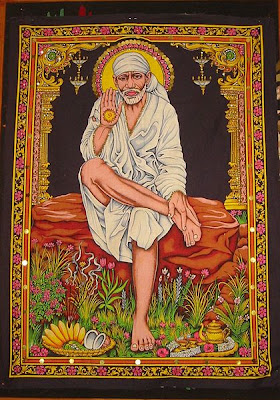
PHOTO GALLARY :



WHERE TO STAY IN SHIRDI?
Hotel "The Pilgrims Inn" self contained rooms (50 blocks).
Shirdi Trust has provided Rooms to stay in near to Shirdi Sai Baba Temple..
Return to Shirdi :
In 1858 Sai Baba returned to Shirdi. Around this time he adopted his famous style of dress consisting of a knee-length one-piece robe (kafni) and a cloth cap.
Ramgir Bua, a devotee, testified that Sai Baba was dressed like an athlete and sported 'long hair flowing down to the end of his spine' when he arrived in Shirdi, and that he never had his head shaved.
It was only after Baba forfeited a wrestling match with one Mohdin Tamboli that he took up the kafni and cloth cap, articles of typical Sufi clothing.
This attire contributed to Baba's identification as a Muslim fakir, and was a reason for initial indifference and hostility against him in a predominantly Hindu village.
According to B.V. Narasimhaswami, a posthumous follower who was widely praised as Sai Baba's "apostle", this attitude was prevalent up to 1854 even among some of his devotees in Shirdi.
Sai Baba participated in religious festivals and was also in the habit of preparing food for his visitors, which he distributed to them as prasad. Sai Baba's entertainment was dancing and singing religious songs.
Historical sources :
Biographers of Sai Baba (e.g. Govindrao Raghunath Dabholkar, Acharya Ekkirala Bharadwaja, Smriti Srinivas, Antonio Rigopolous) have based their writing on primary sources.
One such source is the Shirdi Diary by Ganesh Shrikrishna Khaparde, which describes every day of the author's stay at Shirdi.
Speculation about the unknown episodes of Sai Baba's life are primarily based on his own words.
The most important source about Sai's life is the Shri Sai Satcharita, Shri-Sai-Satcharitra written in Marathi in 1916 by Govindrao Raghunath Dabholkar, whom Sai Baba nicknamed Hemadpant.
Consisting of 53 chapters, it describes Sai Baba's life, teachings, and miracles. The book compares Sai Baba's love to a mother's love: caring and loving, but reprimanding when needed.
It describes Baba's lifestyle, his selfless attitude, and his love for his devotees. The book describes how one should surrender one's egoism at God's feet and trust one's guru.
It explains how God is supreme and His devotees should trust Him and love Him. It teaches that God is omnipresent in all living things, so that everything on Earth must be treated with love and respect.

Teachings and practices :
Sai Baba opposed all persecution based on religion or caste.
He was an opponent of religious orthodoxy – Christian, Hindu and Muslim.[24] Although Sai Baba himself led the life of an ascetic, he advised his followers to lead an ordinary family life.
In his personal practice, Sai Baba observed worship procedures belonging to Hinduism and Islam; he shunned any kind of regular rituals but allowed the practice of namaz, chanting of Al-Fatiha, and Qur'an readings at Muslim festival times.
Occasionally reciting the Al-Fatiha himself, Baba also enjoyed listening to moulu and qawwali accompanied with the tabla and sarangi twice daily.
Sai Baba encouraged his devotees to pray, chant God's name, and read holy scriptures. He told Muslims to study the Qur'an, and Hindus to study texts such as the Ramayana, Bhagavad Gita, and Yoga Vasistha.
He advised his devotees and followers to lead a moral life, help others, love every living being without any discrimination, and develop two important features of character: unflinching perseverance (Shraddha) and waiting cheerfully with patience and love(Saburi). He criticized atheism.
In his teachings, Sai Baba emphasized the importance of performing one's duties without attachment to earthly matters, and of being content regardless of the situation.

Film and television :
Sai Baba has been the subject of several feature films in many languages produced by India's film industry.
Sai Baba made twelve assurances to his devotees :
1. Whosoever puts their feet on Shirdi soil, their sufferings will come to an end.
2. The wretched and miserable will rise to joy and happiness as soon as they climb the steps
of Dwarakamayi.
3. I shall be ever active and vigorous even after leaving this earthly body.
4. My tomb shall bless and speak to the needs of my devotees.
5. I shall be active and vigorous even from my tomb.
6. My mortal remains will speak from my tomb.
7. I am ever living to help and guide all who come to me, who surrender to me, and who seek refuge in
me.
8. If you look at me, I look at you.
9. If you cast your burden on me, I shall surely bear it.
10. If you seek my advice and help, it shall be given to you at once.
11. There shall be no want in the house of my devotee.
12. If you take a step towards me, I will take 100 steps towards you.
Shirdi Sai Baba Arati :

ToListen Live Sai Baba Aarati Click here..
122 kms from Nashik is the abode of one of Maharashtra's most revered saint - Sai Baba of Shirdi.
Popularly known as the 'Child of God', Sai Baba preached tolerance towards all religions and the message of universal brotherhood.
Every activity at Shirdi revolves around the vast temple complex dedicated to Sai Baba.
Devotees start queuing up in the early hours of dawn to catch a glimpse and seek the blessings of the life-size statue of Sai Baba.
Built In :
Built his first temple at Bhivpuri, Karjat in 1916.
HOW TO REACH SHIRDI?
Nearest airport : is Aurangabad.
Nearest railway : Shirdi, on the Manmad-Daund section of central Railway.
By Bus :
Mumbai-Shirdi,296 kms. (Mumbai-Nashik-Niphad-Yeola-Shirdi)
Nashik-Shirdi 112 kms.
Aurangabad-Shirdi 126 kms.(Aurangabad-Vaijapur Yeola-Kopargaon-Shirdi)
Pune-Shirdi,183 kms. (Pune-Kalamba-sangmner-Talegaon-shirdi).
State Transport buses ply regularly from Mumbai, Nashik, Ahmednagar, Aurangabad, Pune and kopargaon.
Highlights :
Thursday is marked by special pujas and darshan of the Sai Baba statue.
There are other places of interest that devotees can visit as well including Dwarkamani Mosque where the Baba meditated and slept on alternate nights.
Near the mosque, in a corridor is the dhuni or eternal flame that burns day and night.
Other places of importance are the Gurusthan, the Kandoba Temple, Shani Mandir, Narsimha Mandir, Changdev Maharaj Samadhi and the Sakori Ashram.
ABOUT SHIRDI SAI BABA :
Born : Unknown
Died : October 15, 1918.
Era : 19th to 20th Century
Region : India
Sai Baba of Shirdi, also known as Shirdi Sai Baba (Marathi: शिर्डीचे श्री साईबाबा, was an Indian guru, yogi, and fakir who is regarded by his Hindu and Muslim devotees as a saint.
Many Hindu devotees - including Hemadpant, who wrote the famous Shri Sai Satcharitra - consider him an incarnation of Lord Krishna while other devotees consider him as an incarnation of Lord Dattatreya.
Many devotees believe that he was a Satguru, an enlightened Sufi Pir, or a Qutub. No verifiable information is available regarding Sai Baba's birth and place of birth.
Sai Baba's real name is unknown. The name "Sai" was given to him upon his arrival at Shirdi, a town in the west-Indian state of Maharashtra. Mahalsapati, a local temple priest, recognized him as a Muslim saint and greeted him with the words 'Ya Sai!', meaning 'Welcome Sai!'.
Sai or Sayi is a Persian title given to Sufi saints, meaning 'poor one'.However Sāī may also refer to the Sanskrit term "Sakshat Eshwar" or the divine.
The honorific "Baba" means "father; grandfather; old man; sir" in Indo-Aryan languages. Thus Sai Baba denotes "holy father", "saintly father" or "poor old man".
Sai Baba remains a very popular saint, especially in India, and is worshipped by people around the world.
He had no love for perishable things and his sole concern was self-realization. He taught a moral code of love, forgiveness, helping others, charity, contentment, inner peace, and devotion to God and guru.
Sai Baba's teaching combined elements of Hinduism and Islam: he gave the Hindu name Dwarakamayi to the mosque he lived in, practiced Hindu and Muslim rituals, taught using words and figures that drew from both traditions, and was buried in Shirdi.
One of his well known epigrams, "Sabka Malik Ek " ("One God governs all"), is associated with Islam and Sufism.
He always uttered "Allah Malik"("God is King")
PHOTO GALLARY :


Hotel "The Pilgrims Inn" self contained rooms (50 blocks).
Shirdi Trust has provided Rooms to stay in near to Shirdi Sai Baba Temple..
Return to Shirdi :
In 1858 Sai Baba returned to Shirdi. Around this time he adopted his famous style of dress consisting of a knee-length one-piece robe (kafni) and a cloth cap.
Ramgir Bua, a devotee, testified that Sai Baba was dressed like an athlete and sported 'long hair flowing down to the end of his spine' when he arrived in Shirdi, and that he never had his head shaved.
It was only after Baba forfeited a wrestling match with one Mohdin Tamboli that he took up the kafni and cloth cap, articles of typical Sufi clothing.
This attire contributed to Baba's identification as a Muslim fakir, and was a reason for initial indifference and hostility against him in a predominantly Hindu village.
According to B.V. Narasimhaswami, a posthumous follower who was widely praised as Sai Baba's "apostle", this attitude was prevalent up to 1854 even among some of his devotees in Shirdi.
Sai Baba participated in religious festivals and was also in the habit of preparing food for his visitors, which he distributed to them as prasad. Sai Baba's entertainment was dancing and singing religious songs.
Historical sources :
Biographers of Sai Baba (e.g. Govindrao Raghunath Dabholkar, Acharya Ekkirala Bharadwaja, Smriti Srinivas, Antonio Rigopolous) have based their writing on primary sources.
One such source is the Shirdi Diary by Ganesh Shrikrishna Khaparde, which describes every day of the author's stay at Shirdi.
Speculation about the unknown episodes of Sai Baba's life are primarily based on his own words.
The most important source about Sai's life is the Shri Sai Satcharita, Shri-Sai-Satcharitra written in Marathi in 1916 by Govindrao Raghunath Dabholkar, whom Sai Baba nicknamed Hemadpant.
Consisting of 53 chapters, it describes Sai Baba's life, teachings, and miracles. The book compares Sai Baba's love to a mother's love: caring and loving, but reprimanding when needed.
It describes Baba's lifestyle, his selfless attitude, and his love for his devotees. The book describes how one should surrender one's egoism at God's feet and trust one's guru.
It explains how God is supreme and His devotees should trust Him and love Him. It teaches that God is omnipresent in all living things, so that everything on Earth must be treated with love and respect.

Teachings and practices :
Sai Baba opposed all persecution based on religion or caste.
He was an opponent of religious orthodoxy – Christian, Hindu and Muslim.[24] Although Sai Baba himself led the life of an ascetic, he advised his followers to lead an ordinary family life.
In his personal practice, Sai Baba observed worship procedures belonging to Hinduism and Islam; he shunned any kind of regular rituals but allowed the practice of namaz, chanting of Al-Fatiha, and Qur'an readings at Muslim festival times.
Occasionally reciting the Al-Fatiha himself, Baba also enjoyed listening to moulu and qawwali accompanied with the tabla and sarangi twice daily.
Sai Baba encouraged his devotees to pray, chant God's name, and read holy scriptures. He told Muslims to study the Qur'an, and Hindus to study texts such as the Ramayana, Bhagavad Gita, and Yoga Vasistha.
He advised his devotees and followers to lead a moral life, help others, love every living being without any discrimination, and develop two important features of character: unflinching perseverance (Shraddha) and waiting cheerfully with patience and love(Saburi). He criticized atheism.
In his teachings, Sai Baba emphasized the importance of performing one's duties without attachment to earthly matters, and of being content regardless of the situation.

Film and television :
Sai Baba has been the subject of several feature films in many languages produced by India's film industry.
Year
|
Film
|
Title role
|
Director
|
Language
|
Notes
|
1977
|
Shirdi ke Sai Baba
|
Ashok V. Bhushan
|
Hindi
|
Also featuring Manoj Kumar, Rajendra Kumar, Hema Malini,Shatrughan Sinha, Sachin, Prem Nath
|
|
1986
|
Telugu
|
Dubbed into Hindi as Shirdi Sai
Baba Ki Kahani, into Tamil asSri Shiridi Saibaba
|
|||
1989
|
Bhagavan Shri Sai Baba
|
Sai prakash
|
Kannada
|
||
1993
|
Sai Baba
|
Yashwant Dutt
|
Babasaheb S. Fattelal
|
Marathi
|
Also featuring Lalita Pawar
|
2001
|
Shirdi Sai Baba
|
Hindi
|
Also featuring Dharmendra, Rohini Hattangadi, Suresh Oberoi
|
||
2005
|
Ishwarya Avatar Sai Baba
|
Hindi
|
Composite movie drawn from Sagar's Sai Baba (TV series).
|
||
2010
|
Hindi
|
Released in 2008. Also featuring Manoj Kumar, Divya Dutta,Rohini Hattangadi, Zarina Wahab and Anup Jalota as Das Ganu.
|
|||
2012
|
Telugu
|
(filming)
|
Sai Baba made twelve assurances to his devotees :
1. Whosoever puts their feet on Shirdi soil, their sufferings will come to an end.
2. The wretched and miserable will rise to joy and happiness as soon as they climb the steps
of Dwarakamayi.
3. I shall be ever active and vigorous even after leaving this earthly body.
4. My tomb shall bless and speak to the needs of my devotees.
5. I shall be active and vigorous even from my tomb.
6. My mortal remains will speak from my tomb.
7. I am ever living to help and guide all who come to me, who surrender to me, and who seek refuge in
me.
8. If you look at me, I look at you.
9. If you cast your burden on me, I shall surely bear it.
10. If you seek my advice and help, it shall be given to you at once.
11. There shall be no want in the house of my devotee.
12. If you take a step towards me, I will take 100 steps towards you.
Shirdi Sai Baba Arati :

ToListen Live Sai Baba Aarati Click here..
Read More
Add your Comment
0
comments


.jpg)


